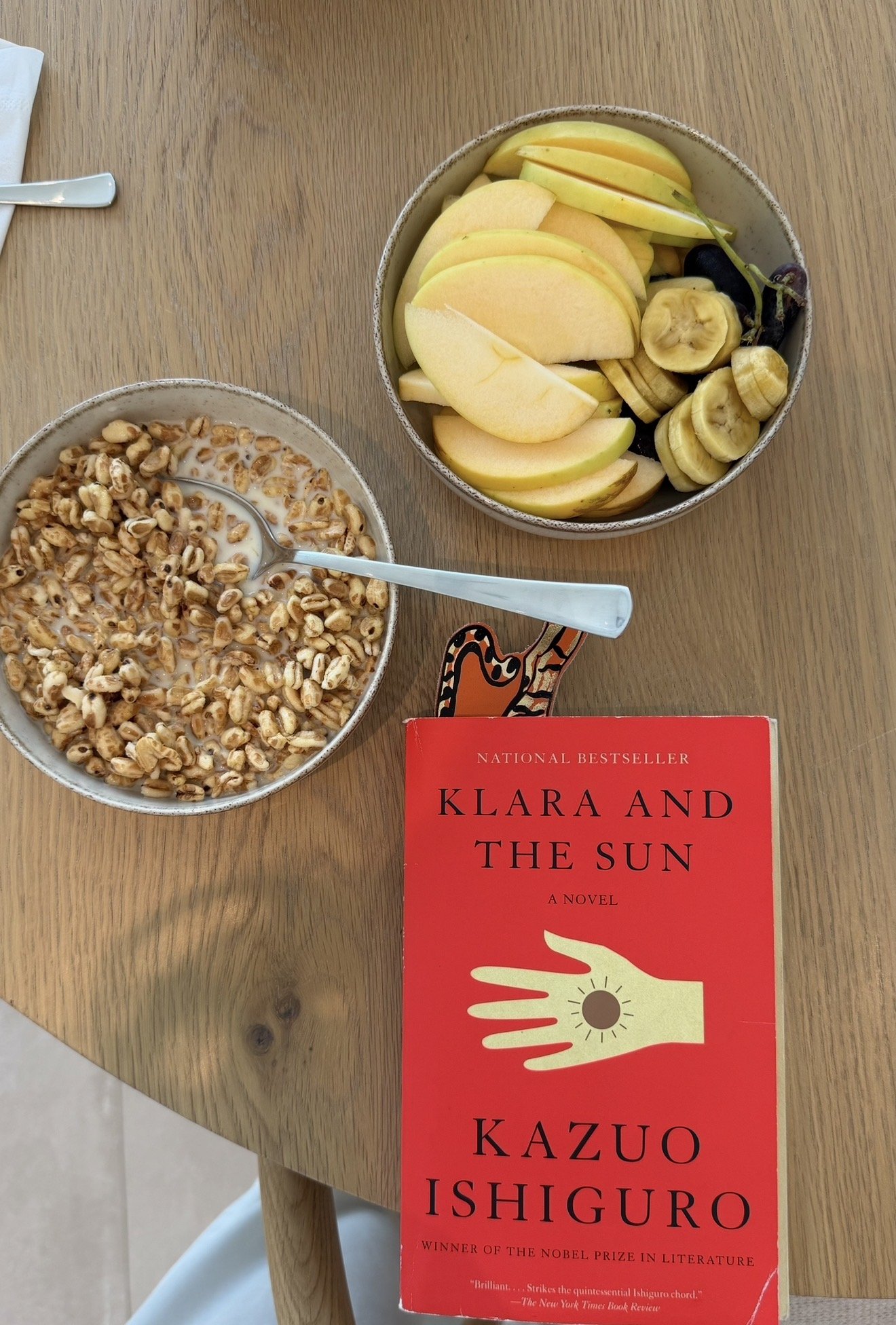
A Book Review: Klara and the Sun
By Kazuo Ishiguro
Klara and the Sun by Kazuo Ishiguro is a book about a world where Artificial Friends exist, robots who are able to learn, understand and pick up patterns about humans in order to become fulfilling companions that are able to enrich their owners’ lives. The book follows the journey of Klara, an Artificial Friend, from being in a store with her fellow AFs, to being sold to a little girl named Josie, to accompanying Josie through illness, recovery and growing pains. Through following Klara’s journey, you get to understand the world this book is set in, and it feels vividly realistic. There are “lifted” kids, those who are genetically modified and therefore more superior and competitive in the world, versus those who are not. It is apparent, though, that becoming lifted also carries a risk of developing a serious illness, which Josie suffered from, as well as Josie’s sister, who passed from this decision of being lifted.
Kazuo Ishiguro, the author, has such a talent for describing the future in a way that seems truly possible. He wrote this book way ahead of time; maybe reading it then, you wouldn’t really be able to conceptualise a future like this. But living in this modern day, where artificial intelligence is improving by the minute and therefore integrating into our lives more and more with every advancement, you can.
I see a future where there are robots around us, and where the line between humanity and AI is so blurred. Even throughout reading this book, Klara, whilst specifically described as exceptional in her observation skills, becomes more human by the minute. You feel empathy towards her, and you could truly pinpoint her own empathy, which is a wild thing to experience towards essentially a robot. In fact, there’s an interaction in the book between Klara and the neighbour, when the neighbour actually compares her to an appliance, and I caught myself feeling offended on Klara’s behalf, but the reality is she is made of the same technology.
All that being said, it’s very thought-provoking to start to picture a world like that, and how that could change our value as humans. A lot of people have this hate towards AI, because they see how, as the technology improves, it is actually replacing humans in jobs and making the reliance on people less and less, which in turn I can see decreasing the value of humans.
Now more than ever, this topic has been resurfacing in conversations all around us, in our workplaces, our personal lives, everywhere we go. The advancement of AI cannot be ignored. So reading this book has been so thought-provoking and relevant.
There’s a climax in the book when Josie’s father is conversing with Klara about the possibility of Klara becoming Josie and “continuing her” if Josie passes away. Klara was confident in her ability to be Josie and continue her during this conversation, and the father himself feared that he might also one day love Klara as if it was Josie. He feared the implications of that, which are that there is nothing really special about Josie, or any of us for that matter. Towards the end of the book, Klara reflects on this matter and agrees that the special thing about Josie wasn’t what’s inside her, or her heart; it was inside the people who loved her and how they felt about her.
This specific conversation in the book really had me thinking, and my thoughts are quite different. I disagree with the concept that there is nothing within us that AI cannot replicate. To me, that’s only true in the work sense, when it comes to optimisation and productivity. No matter how much AI improves, I feel like us humans have something that is not imitatable, something humans cannot create no matter how much they try, nor could AI mimic; it is God-given. It’s our souls, our essence, the very things that make us different from one another. It is what makes us fall in love, what breaks our hearts, what makes us form deep connections; it is why we experience grief and pleasure. I really do not see AI replacing that. I also really believe in Art and self-expression and authenticity, which can never be mimicked or created.
I also disagree somewhat with Klara; equating external love with what makes us as individuals valuable or different or not-imitatable is too simple and diminishing to what we are as individuals. It is as if our worth is reliant on outside factors, rather than how we behave, think and love. It’s like saying that if everyone loved Klara so much, the plan of Klara continuing Josie could succeed. And I think we as individuals are more than who loves us.
What I also found peculiar was Klara’s relationship with the Sun. Klara felt that the Sun had some sort of superpower and ability to heal people and impact their destiny. Klara prayed to the Sun and also relied on the Sun for guidance. This makes me think about how important it is to believe in a higher power. There are a lot of things in this world we cannot understand; no matter how much science can explain, there still remains so much that is unexplainable. When we encounter that, we rely on a higher power, and in this book seven AI does. I resonate with that a lot, because to me, my relationship with God has changed the course of my life and how I navigate it and how I overcome hardships and make progress. It was so interesting to be in a world where even AI needed that.
I feel like there was a contrast between the first half of the book and the second. In the first half, things moved very slow and it took time to get accustomed to the characters and like them. There were so many descriptions and details about dull things, which made it a bit harder for me to read, but I felt an extreme shift towards the middle of the book, where it became more entertaining and many plots were unravelling. So don’t judge the book by how it begins, if you persevere through the tough start you will find solace in the way it unfolds.
I do recommend reading this book, and the thing I’ve found about Kazuo Ishiguro’s books is that you think way more about them long after you’ve read them. It’s the type of stories that reappear in your mind when you least expect them to and carry on with you. I’d give this book a 5/5!