A Review: If I Had Your Face
A Review: If I Had Your Face by Frances Cha
Five women, one officetel. The envy of other lives. Choosing whimsy anyway.
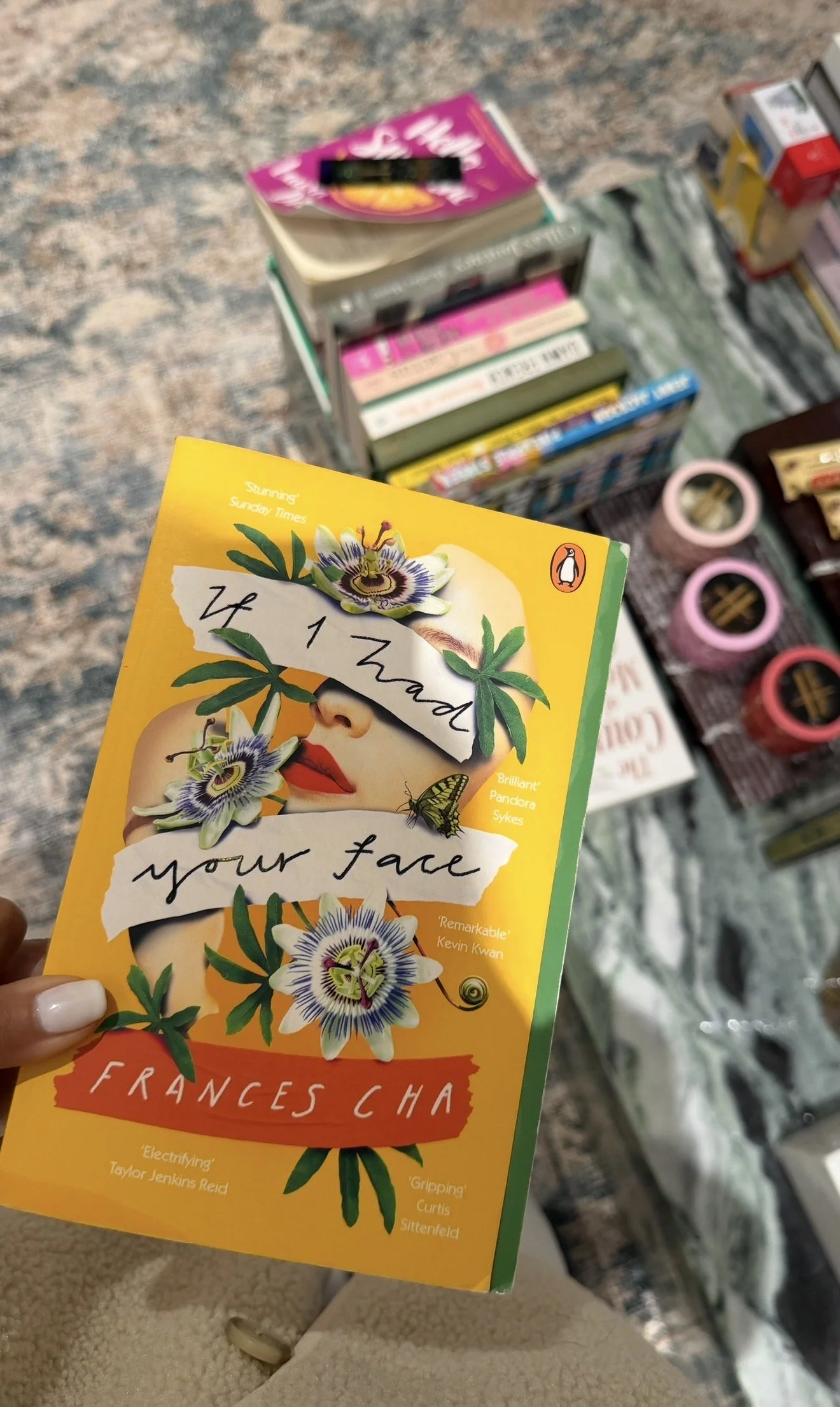
When I read the context of the book, that it would be taking place in Seoul, I hesitated, because I was craving something relatable to me. A setting I could see my story in. Little did I know that I'd find pieces of myself scattered in all the characters in this book.
Each chapter was from the point of view of one of the women who lived in the same officetel. An officetel (오피스텔), which I came to learn from the book, is "a type of building common in South Korea that combines an office and a hotel-style studio apartment. The name literally comes from office + hotel."
Every chapter was a different story, and they were all linked to each other by a thin strand that threaded throughout the book, and kept getting thicker and thicker as the book ended. The thread was thin in the beginning, because the characters' lives (their childhoods, how they ended up where they are now, their relationship status, their work) varied wildly. But I found that as I continued reading, the thread thickened, because womanhood is a universal experience.
I found myself in all of them, even though at face value there are no explicit commonalities between us. I was invested in each of their lives, and as I got to know each of them individually, I found myself wanting to know more, getting closer to the characters, unmasking the different layers of who they were. I was surprised by almost every one of them; my first impression and my lasting one are vastly different. The author captured the complexity of understanding a human being, the layerity of being human. How context makes a huge difference in how we see people and relate to them. When we know someone's story, their upbringing, their relationship with their parents, it helps us understand who they are so much more. Also, how we're unboxable; I'm so many people and I'm myself at once.
All this pondering of what makes us who we are made me reflect on my personal views. When I was younger I used to believe bad people didn't exist, that all humans at their core were good, and it was the circumstances and upbringing that make people do bad things. As I grew older and experienced the world and came in contact with the bad firsthand, my opinions started to change. I started to veer towards believing some people at their core are rotten, that evil exists as a natural form. This book brought me closer to my views when I was more innocent. To my childhood. I couldn't hate any of the characters, even if they did hateable things. I found myself defending, not even excusing, their bad behavior.
Also, the idea of a perfect life, perfect job, perfect relationship, is that even real? Throughout the book you see how every character envied some aspect of the other person's life, and it kind of made me feel that no one will ever be happy or satisfied when they hang their happiness to an aspiration, making it unreachable in the everyday life. I'll be happy when… I'm married, I land that job, I make more money, etc. Is that what brings happiness? Real happiness will only exist once one learns to harvest it from their current circumstances and mine it out of the ordinary days. Looking outward, comparing to other people's lives, it steals from your happiness.
Another theme that resonated with me is how we look at people with visible physical disabilities. One of the women in the book had a disability, she was mute, and it really shaped how people experienced her and how she was received in the world. Sometimes it benefited her, the caution and grace from society. Sometimes it demoted her in the world, deeming her unworthy of basic rights. Which, through this character's story, became more absurd to me. How differently we treat people with physical, visible disabilities. I repeat physical and visible, because there are disabilities that are not seen with the naked eye. There are people so worthy of the grace and care we do not elect to give them, because they do not have physical visible disabilities. There are also so many people who actually need to be demoted and deemed unworthy by society, but they are not, because we can't see what makes them less of a human. It's all very unfair, how we allocate and distribute our judgment in society. The character herself surprises you, and takes you on a roller coaster of how you rank her on the capability scale, and I loved that.
A thought that also stood out to me was the contrast between the self-defense mechanisms we learn to use for coping, and how differently each one can shape our lives. There are people who cope by lowering their expectations, by expecting the worst of people, by denying themselves the pleasure of having hope, because then that will lead to your soul being crushed. I understand that. I've done that. I've gone through an experience where someone I trusted and fully let in myself completely shocked me. I made them my chosen family, shared all my resources with them, time, effort, relationships, completely let them into my home and heart and childhood trauma, only to find out in a series of unfortunate events how evil they were. How every kindness I gave them, big or small, was met with seething jealousy. It was a slow burn, their plan to upend my life and relationships, but the torment was abrupt. Anyways, I'm way past that now, but following that experience I locked up my heart and started looking at everyone as guilty until proven innocent. I trained my mind and body to see the doom so I can prepare for it when it happens.
Then there are the ones who throw themselves into the world, fearless, with a solid belief that everything will always work out, and when it doesn't, they have a whimsical way of convincing themselves it hasn't ended yet. In their world there is a row of infinite doors, of no end; if one doesn't open, try the next one. Surely, one will open. There is no way all the doors in the world are closed. They let people in easily and give generously, because they find joy in that. They're not naive, but they are confident in their ability to handle the worst. They always find the at least we have…, at least we learned…, etc. After I rebuilt from that experience, which took years and so many experiences, and unsolicited outpouring of love from my community, my faith in humanity restored a bit, but my faith in myself came back full throttle. And now I try to find the "at leasts" in everything, rather than be shackled with fear.
The former are always unhappy; they are uncomfortable with the feeling of joy. They despise it and get rid of it instantly. And the latter are always positive and happy, even in the darkest of times. They find a light, even if they have to burn it from their own flesh. They are allergic to being sad for too long.
It's interesting who we choose to be. I am, and was, both versions throughout different chapters of my life. But for me, I have found that being positive has suited me better, even if it is the harder coping mechanism to maintain. I'm naturally whimsical, and it is how I breathe. Even if it often feels lonely, because people are always trying to make you "realistic" to avoid being let down. It takes a lot of effort to maintain my whimsy, but it is worth it, for me at least.
This review has been chaotic, I acknowledge that, but so were my feelings when I read the book. It evoked prolific thoughts about life. I was so interested in it and read it quickly. It's the type of book that depends on the reader. You could read it surface-level and enjoy it as purely a piece of entertainment. Like reality TV. Or you could deep dive and stop and philosophize over every story line (which is what I did). Also like reality TV, some people dig deep and think more theoretically about it.
Either way, you'll gain so much out of it, whether enjoyment, or self-assessment and discovery.