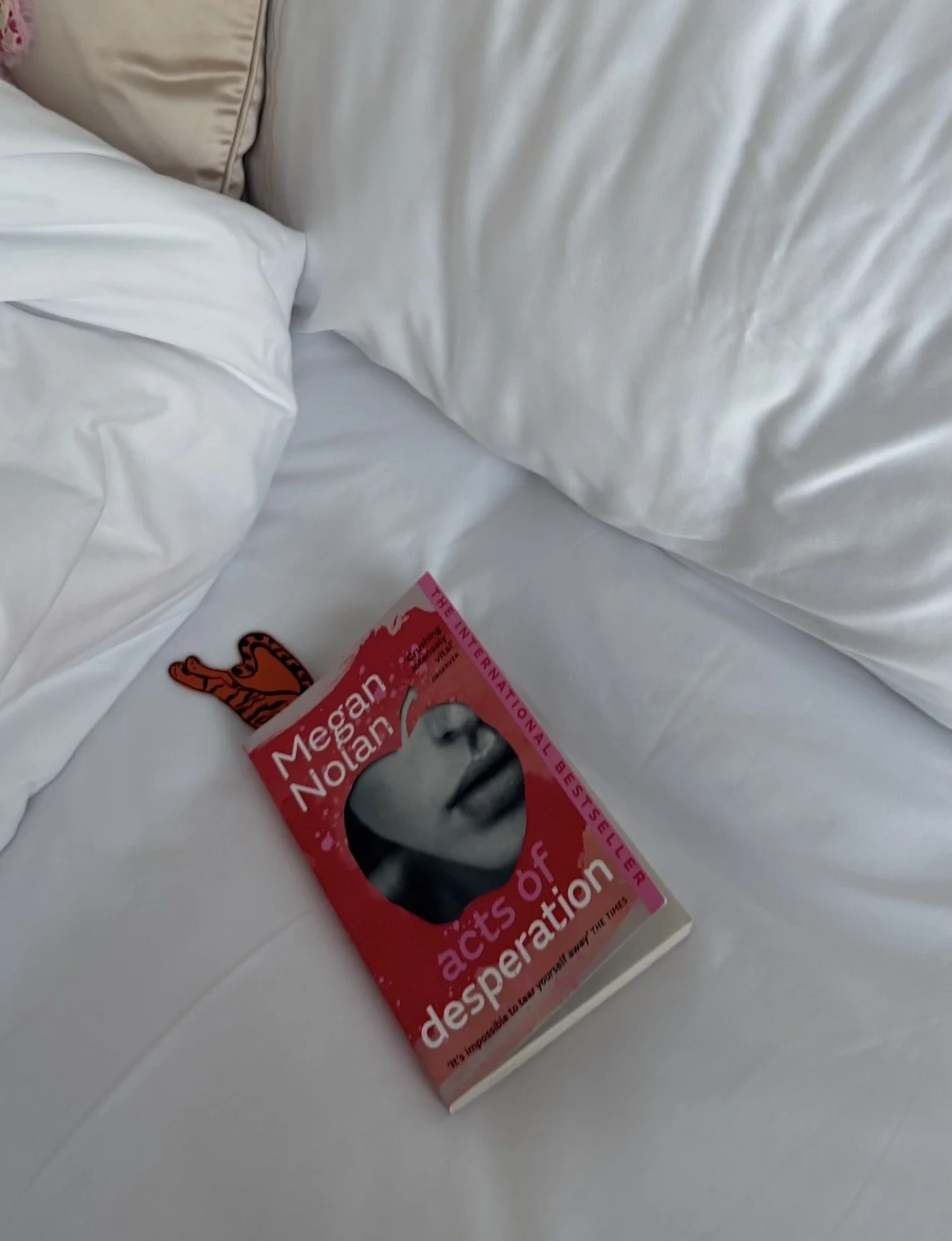
A Book Review: Acts of Desperation
Acts of Desperation by Megan Nolan is a book that follows the protagonist's love life and specifically focuses on a toxic relationship with a man quite a bit older than her who seemingly is in and out of a relationship with another woman. The book gives you insight into the main character's unfiltered, raw thoughts throughout her experiences with this partner, and it shows you how her view of herself and her previous experiences with other lovers shape the way she interacts with and reacts to the range of transgressions by her current partner. The book mirrors a universal female experience of being in love with someone who does not reciprocate and therefore being in angst, but it magnified it, zoomed in on it and exaggerated it.
I honestly felt that the book lacked a climax, a turn of events, a fully developed story. It felt like the entire book was a zoomed-in lens on her relationships and how she navigates the gruesome day-to-day interactions with a toxic partner.
I hated the book on multiple levels.
Yes, the book is titled Acts of Desperation, so we should expect to read about the lengths of desperation the protagonist goes to in order to gain Ciaran's (the partner's) acceptance and love, but I just couldn't relate. Seeking reciprocation for your feelings towards a person you are in love with is a universal female experience, but the way the protagonist goes about it is very unrelatable to me. I didn't understand the fixation with him, I didn't relate to the lengths she went to. I could not see myself in her, or anyone in the book for that matter, so it made it difficult for me to enjoy it. I would like to say that when we discussed this book in my book club I realised that my personal opinion in this aspect is very individual to me. Because many of the girls did relate, and they recalled friends who acted that way or they themselves when they were younger did extreme things for male approval. Our book club was split in two: women like me who absolutely could not understand, and women who really did. I think I come from a very shielded, conservative background and that might play a role in how "quiet" my early adolescence was compared to the main character's.
I felt like the book was authored by someone who hated women. Despite the author clearly stating throughout the book that this was not the case, it did do that to me: it romanticised female suffering. It made female suffering almost something artistic, something normalised, something women should seek out. For example, the protagonist says: "I did not just love Ciaran but loved him darkly, wrongly. Losing someone you love in those ways can turn you not only mad but wicked too." I felt there were moments where acts of violence and aggression against the protagonist (a woman) were happening in the book and, instead of rejecting them, the author was glorifying them and beautifying them. I really did not like that.
Throughout the book there was a blurred line when it came to consent and sexual assault. It was so blurred to the point that you really did not know who was the victim and who was the aggressor. I felt the protagonist herself did not know, and that is a sad part of the reality of being a woman. I really empathised with the protagonist at many moments on this matter, but I really wished the lines were cleared up at least by the end of the book as a sort of resolution or coming to an understanding or even closure, but they weren't.
If that isn't clear yet, I really did not like the protagonist. I felt she was self-indulgent to a fault and, although she was a victim at times, she was also a victimiser. The way she recalled events and assessed them made it so very hard to empathise with her. This comes from the fact that we do not really get an insight into why the protagonist is the way she is. Usually behaviour like this comes from a specific trauma, and we don't get to see that with the protagonist. But we did get to see it with Ciaran: when he met with his dad, we were able to understand why he was the way he is, or at least conceptualise or theorise it. With her, we couldn't. As unreliable as she was, I do think she was very honest in sharing her thoughts. It felt like throughout the book you did live inside her mind. I didn’t like living in her mind, it felt dark, wicked and twisted for me. I think she was too self-centred and too fixated on the male gaze. Throughout the book you see how little female friendships meant to her, how little anything actually meant to her compared to male approval. She used self-harm for attention and described it in a way that might actually undermine the experience of someone who actually suffers from self-harming tendencies. I honestly saw no character development, it felt like the same person with the same mindset throughout the book, despite the protagonist herself trying to carve out differences from when she was younger to now.
All in all, there are some books I read that feel like a love letter to women and womanhood, this was not one of them. It felt like an unsatisfying read, where you don't get closure on anything, you feel like why did I read this? What is the point of this? It just did not feel like a finished plot. We don't get to see what she learns from this relationship. The book ends with her moving to Greece, but what is the actual end? Despite my dislike of the plot, I did like the author's style of writing, I felt it was funny at times and poetic even. This book garnered a lot of attention online and so many people actually loved it, so I do acknowledge my opinion might not be a popular one, but it is mine nevertheless.
I'd rate this book a 1/5, and the one point is solely for the style of writing.